Student Success Champion: Carolyn Johns
An Unexpected Path to STEM Leadership
The career path to directing a mathematics tutoring center rarely begins backstage of a theater. Yet for Carolyn Johns, assistant director of the Math and Statistics Learning Center (MSLC), a background in the arts was the unexpected prelude to a career defined by leadership in STEM education.
Carolyn’s journey began at Earlham College, where she graduated in 2009 with a degree in Theatre Arts and a minor in Japanese. At the time, her sights were set on a future in Japanese theater set and lighting design. However, possessing what she describes as “a math brain” — and encouraged by a timely parental nudge — she decided to double major in Mathematics. This decision proved to be the launching pad for her higher education career, blending a designer’s sense of connection with a mathematician’s analytical rigor.
Her academic evolution continued with two master’s degrees from the University of Akron, ultimately culminating in a Ph.D. in STEM Education from Ohio State. Today, this multifaceted background informs her work as a “scholar-practitioner,” allowing her to bridge the gap between complex theoretical research and the practical art of teaching.
A Scholar-Practitioner
As a scholar-practitioner, Carolyn sees the MSLC as not only a student support unit, but also a living laboratory for mathematics education. She explains that “My position doesn’t specifically have research attached, so when I do research, it’s because I enjoy it as a fun intellectual challenge.” Yet her impressive body of scholarly research has laid the foundation for everyday excellence at the MSLC, with a focus on tutoring pedagogy, tutor training, and organizational improvement.
Carolyn’s research on tutoring pedagogy and training suggests that effective tutoring requires more than just subject-matter expertise; it requires a specialized form of mathematical knowledge designed specifically for instruction. Thus at the MSLC, tutors are trained not just to “show and tell” how to solve an equation, but to understand the pedagogical moves necessary to guide a peer through active conceptual thinking. This semester, Carolyn is furthering this investment by piloting "Learning Assistants" — undergraduate peers who are specifically trained in pedagogical skills to provide high-level support directly within the classroom environment.
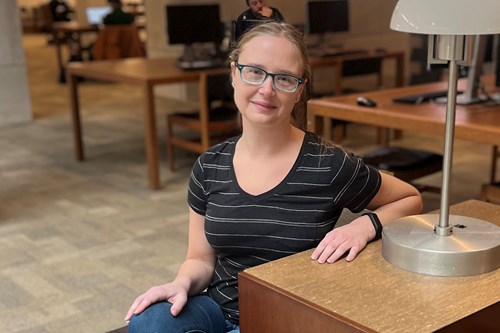
“I’m constantly using data, trying to more efficient,” said Johns. “And not only efficiency, but ways to do things better.”
Carolyn’s research on organizational improvement helps the MSLC use evidence and assessment to be efficient, accountable, and agile. For example, when post-pandemic data showed a sharp decline in Zoom engagement, she pivoted the center’s organizational model toward a unique system of pre-scheduled weekly appointments, in which the same students meet the same tutor at the same time across the semester. This shift moved the center away from a reactive “drop-in” service to a stable and consistent cadence that fosters long-term student success. As Carolyn notes, “I’m constantly using data, trying to be more efficient. And not only efficiency, but ways to do things better.”
Building Math Confidence
Beyond the logistics of running the MSLC, Carolyn is also a vocal advocate for dismantling the pervasive “math anxiety” that often hinders student progress. She jokes that while few people would admit to being “bad at reading,” there’s widespread cultural acceptance of the phrase “I’m just not good at math.” Carolyn works tirelessly to challenge this self-talk, advising students that the transition from high school to college-level mathematics is a fundamental shift where initial struggle is not only normal but expected. She encourages students to move past the idea that there is only “one lane” to success, instead helping them identify the specific resources and approaches that align with their individual learning styles. As she emphasizes, “You need to have confidence, knowing that, yes, you can be successful in math.”
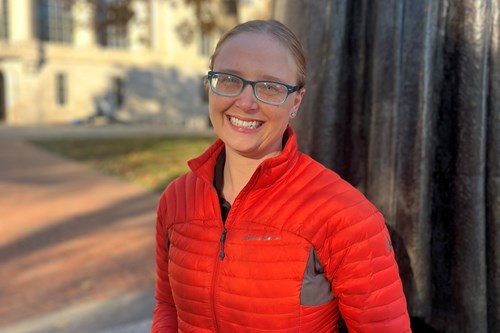
“You need to have confidence, knowing that, yes, you can be successful in math.”
For Carolyn, this definition of success extends beyond the students seeking help; it is equally focused on the 100-plus undergraduate employees she supervises. She views her role as a mentor who prepares them for their future careers, regardless of whether they stay in a STEM field. By teaching foundational professional competencies—ranging from the nuances of workplace relationships to the essential "basics" like punctuality and administrative accuracy — she ensures her staff leave the MSLC as well-rounded professionals.
This investment in people is the most rewarding aspect of her multifaceted role. “The thing that brings me the most joy is when tutors that I had in the past get in touch with me for a recommendation or just to say ‘thank you.’ Hearing about what they’re doing now, life updates — I’m so proud of them.” Whether she is refining a pedagogical framework or celebrating a former student’s career milestone, Carolyn’s work remains rooted in a singular mission: ensuring that every individual who passes through the MSLC leaves more capable and confident than when they arrived.